Eelgrass: Where Did it All Go?
Decades ago, Cape Cod’s coastal ecosystems looked very different than they do today. The decline in eelgrass, an aquatic plant, gained very little attention and unfortunately the lack of eelgrass today has had a major impact on this aquatic region. Why is eelgrass important? It’s luscious green body provides homes for shellfish and juvenile fish […]
The Living Fossil of the Ocean
What species has been roaming the earth for more than 445 million years and still has significant importance in today’s modern society? They have the word crab in their name but actually are more closely related to spiders. If you have already figured out that we are talking about the infamous Horseshoe crab, you are […]
Sea Sponges, Anemones, Tunicates Galore!
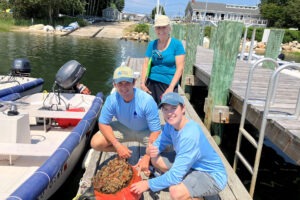
The next time you visit a boat dock, and you want to see some new organisms, lay down on your belly and look to see what is attached along the side of the dock. Throughout Barnstable, there are a variety of colorful plant-like structures creating small ecosystems for small invertebrates like shrimp, crabs, and scallops. […]
Are You an Invasive Crab?
One cannot spend a summer on Cape Cod enjoying the beaches and islands without running into one of the tiniest and mightiest animals in the area: CRABS! The master of camouflage, most people don’t even realize that they are next to one until they decide to move to a new hiding spot. What people also […]
Bioreactor Cranberry Bogs
On July 28th, Barnstable Clean Water Coalition partnered with the Environmental Protection Agency, The Nature Conservancy, and Mount Holyoke College to install a woodchip-based bioreactor in an existing ditch in Hamblin’s Cranberry Bog. What we are hoping to achieve is the nutrient content reduction of water that comes to the surface before it reaches the […]
Who are those people in those waders?
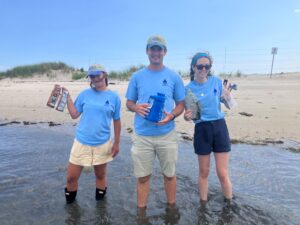
The Marstons Mills River is the connection between our groundwater and the Three Bays Estuary. Because of this, BCWC water sampling assistant and water stewards focus on monitoring the chemical makeup and waterflow at multiple points along the river once a week. We do this by taking small bottle water samples that are then sent […]
Willets: Determined to Thrive
Out on Deadneck/Sampson’s Island, fencing lines the majority of the center of the island for declining coastal bird species like the Piping Plovers and the Least Terns. There is one other bird species that has found the protected area a perfect place for them to lay their eggs and that would be the Willet. Today, […]
Plovers & Terns
Piping plovers Cape Cod is home to numerous shorebirds throughout the summer, one of which being the piping plover. Piping plovers are a small, gray shorebird with an orange bill and black ring around the neck. When not foraging along the wrack line for invertebrates or protecting their chicks, these plovers spend their winters down […]
PFAS: What Are They and Why Do We Care?
On Cape Cod, there has been data collected in past years showing per- and polyfluoroalkyl substances, or PFAS, accumulating in local waters. But what are PFAS and why are they such an urgent matter? PFAS, are synthetically made chemicals used for product application that allow oil and water repellency, temperature resistance, and friction reduction to […]
Algal Blooms
In our last post, we discussed the cause of our algal blooms and associated water quality problems here on the Cape (if you haven’t read it yet, go here!). Today we will be diving into their human and ecological impacts. In both freshwater and saltwater, the impacts are due to toxins being released into the […]